


Using IoT sensors to collect environmental and machine metrics, farmers can make informed decisions, and improve just about every aspect of their work – from livestock to crop farming.
The automated interactive system for optimizing water, nutrient and pesticide inputs is a system composed of a data acquisition module (where sensors are also included), a database and data analysis module. The system is based on a mechatronic operating model that determines in real time the properties of the soil (temperature, humidity, pH) and commands the irrigation and fertilization in function of the chosen vegetable crop.
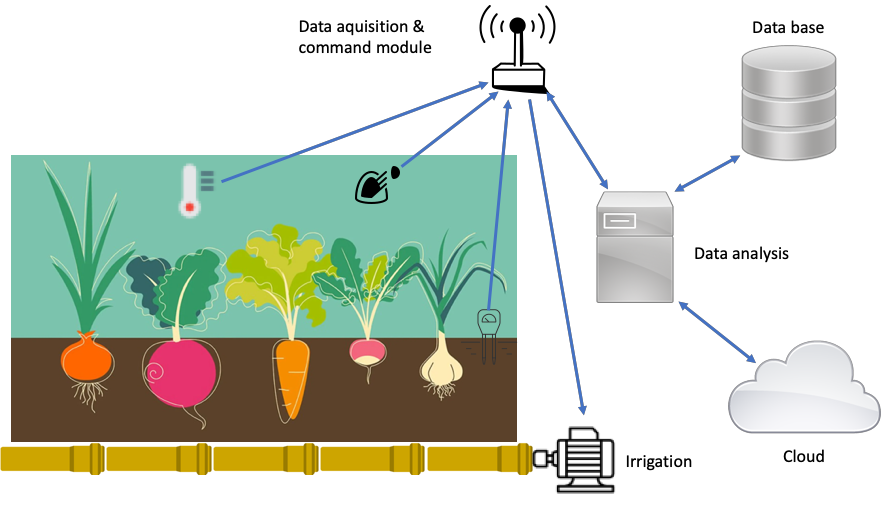
The data acquisition and command module receives the information from the sensors and transforms them into digital data to be delivered to the analysis module. Data acquisition is based on a continuous measurement system of environmental parameters (soil temperature, soil humidity, air temperature, air humidity, brightness). At the same time, the module commands through its relays the opening/closing of the valves for the flow water and nutrients, the start/stop pumps intended to feed the irrigation system.
The data analysis module receives data from the data acquisition and command module. This module includes a database, an AI engine, API's for various data interfaces and a reporting interface.
The database store historical data on soil moisture levels, weather conditions, and crop water usage. The dataset used for analyse includes features like soil moisture, temperature, humidity, precipitation and water consumption. A linear regression model is training with the dataset. The model will learn the linear relationship between the input features (soil moisture, temperature, humidity, precipitation) and the target variable (crop water needs or yield).
To evaluate the model performance Avantaro solution is using a metric named E-squared. R² is a statistical measure that represents the proportion of the variance in the dependent variable (crop water needs) that is predictable from the independent variables (soil moisture, temperature, humidity, precipitation). R² values range from 0 to 1. A higher R² indicates a better fit of the model to the data.
Periodically the model is trained with new data to adapt to changing conditions and improve accuracy over the time and crop yield.
The implemented agricultural solution by Avantaro employs a comprehensive system to optimize irrigation based on real-time environmental data and crop requirements. Overall, the integrated approach of data acquisition, analysis, and continuous learning demonstrates a sophisticated AI-driven solution for precision agriculture.